%22%20stroke-width%3D%2215%22%2F%3E%0A%3Cpath%20d%3D%22M13.092%2045.1466V45.1466C13.092%2033.479%2022.5505%2024.0205%2034.2181%2024.0205L41.3388%2024.0205%22%20stroke%3D%22url(%23paint1_linear_54_376)%22%20stroke-width%3D%2215%22%2F%3E%0A%3Cg%20style%3D%22mix-blend-mode%3Ahue%22%3E%0A%3Cpath%20d%3D%22M14.8325%2024.0664V24.0664C20.1603%2019.1929%2027.0414%2016.4515%2034.2618%2016.4806C38.0674%2016.4959%2041.3388%2016.5207%2041.3388%2016.5207L41.3389%2031.5208H32.2283L9.05078%2031.4922V31.4922C10.5137%2028.8204%2012.383%2026.3923%2014.5919%2024.2949L14.8325%2024.0664Z%22%20fill%3D%22%233E7CF2%22%2F%3E%0A%3C%2Fg%3E%0A%3Cg%20style%3D%22mix-blend-mode%3Ahue%22%3E%0A%3Cpath%20d%3D%22M5.23267%2014.9248H23.2858L27.2611%2014.9248V14.9248C23.3967%2019.2665%2017.8613%2021.75%2012.049%2021.75H5.23267V14.9248Z%22%20fill%3D%22%233E7CF2%22%2F%3E%0A%3C%2Fg%3E%0A%3Crect%20x%3D%2229.1703%22%20y%3D%2233.1172%22%20width%3D%2212.1685%22%20height%3D%2212.1685%22%20fill%3D%22url(%23paint2_linear_54_376)%22%2F%3E%0A%3Cdefs%3E%0A%3ClinearGradient%20id%3D%22paint0_linear_54_376%22%20x1%3D%221.88552%22%20y1%3D%2219.5416%22%20x2%3D%2225.1619%22%20y2%3D%222.39903%22%20gradientUnits%3D%22userSpaceOnUse%22%3E%0A%3Cstop%20stop-color%3D%22%238F2A28%22%2F%3E%0A%3Cstop%20offset%3D%221%22%20stop-color%3D%22%23E15014%22%2F%3E%0A%3C%2FlinearGradient%3E%0A%3ClinearGradient%20id%3D%22paint1_linear_54_376%22%20x1%3D%2240.9736%22%20y1%3D%2223.6878%22%20x2%3D%2213.4003%22%20y2%3D%2244.5584%22%20gradientUnits%3D%22userSpaceOnUse%22%3E%0A%3Cstop%20stop-color%3D%22%23D15D12%22%2F%3E%0A%3Cstop%20offset%3D%221%22%20stop-color%3D%22%23EC2C12%22%2F%3E%0A%3C%2FlinearGradient%3E%0A%3ClinearGradient%20id%3D%22paint2_linear_54_376%22%20x1%3D%2235.2545%22%20y1%3D%2233.1172%22%20x2%3D%2235.2545%22%20y2%3D%2245.2857%22%20gradientUnits%3D%22userSpaceOnUse%22%3E%0A%3Cstop%20stop-color%3D%22%23FFA8AA%22%2F%3E%0A%3Cstop%20offset%3D%221%22%20stop-color%3D%22%23FF3034%22%2F%3E%0A%3C%2FlinearGradient%3E%0A%3C%2Fdefs%3E%0A%3C%2Fsvg%3E)
Move regulated data across clouds — and hand your assessor the proof, without assembling it yourself.
A compliant cross-cloud pipeline, up and running in under 30 minutes.
Every object arrives with one signed record of exactly what moved — and the exchange documentation your SSP needs.
Why two authorized systems still leave the evidence to youThe exchange crosses your authorization boundary. The responsibility stays with you.
A FedRAMP authorization is scoped to an authorization boundary at a stated impact level. Inside it, you rely on control inheritance — the assessed implementation of the platform you build on. Transferring a regulated object to another cloud is an information exchange that crosses that boundary, and the controls that applied inside it still apply to the data once it has left.
NIST is explicit about who owns the risk when data leaves the boundary. SA-9, External System Services:
“The responsibility for managing risks from the use of external system services remains with authorizing officials.”— NIST SP 800-53, SA-9
CA-3, Information Exchange, makes the documentation duty concrete: the interface characteristics, the security requirements and controls, the responsibilities of each system, and the impact level of the information communicated must be documented — and where both systems share the same authorizing official, described in the respective security plans. Four NIST controls define what that exchange must satisfy. In plain terms, each is a requirement placed on you:
- SC-8you must protect information in transit.
- SC-28you must protect information at rest.
- SI-7you must be able to demonstrate that information has not been improperly altered.
- AU-10you must be able to produce a record that establishes who did what.
(FedRAMP Moderate and High requirements, from NIST SP 800-53.)
Two authorized systems, a compliant transfer service — and the evidence is still yours to assemble
The reasonable position is: “Both systems are FedRAMP authorized, at the same impact level, and I move the data with a FedRAMP-authorized service. The exchange is covered.” The authorizations are real. The gap is not authorization — it is evidence.
AWS DataSync and Google Storage Transfer Service both verify the integrity of the bytes they move, and both can report the result of a transfer. But that report is at the job level — a task summary across many objects. The question an assessor asks is narrower: produce the record for this specific object. Answering it, from the native services alone, is where the work lands on you:
- Even enabled, it is a job-level artifact, produced per service, per cloud, in different formats.
- If it was not captured at the time of transfer, reconstructing it means re-reading and re-hashing every object.
- And it is never once. It is recurring work — every transfer, every direction — retained and protected from deletion.
Native tools may verify the transfer. The problem is what the customer has to do later to prove it. The evidence is spread across transfer logs, storage metadata, CloudTrail, Cloud Audit Logs, CloudWatch, task reports, object versions, and retention policies. If those records were not enabled and preserved before the transfer, the object-specific audit trail may not exist.
This is the body of evidence — one signed record per object
Not a pointer to two logging systems and an afternoon of correlation. One signed record, per object, that stands on its own: source and destination both verified, the result cryptographically signed, and independently verifiable — without contacting Server General, and without assembling anything.
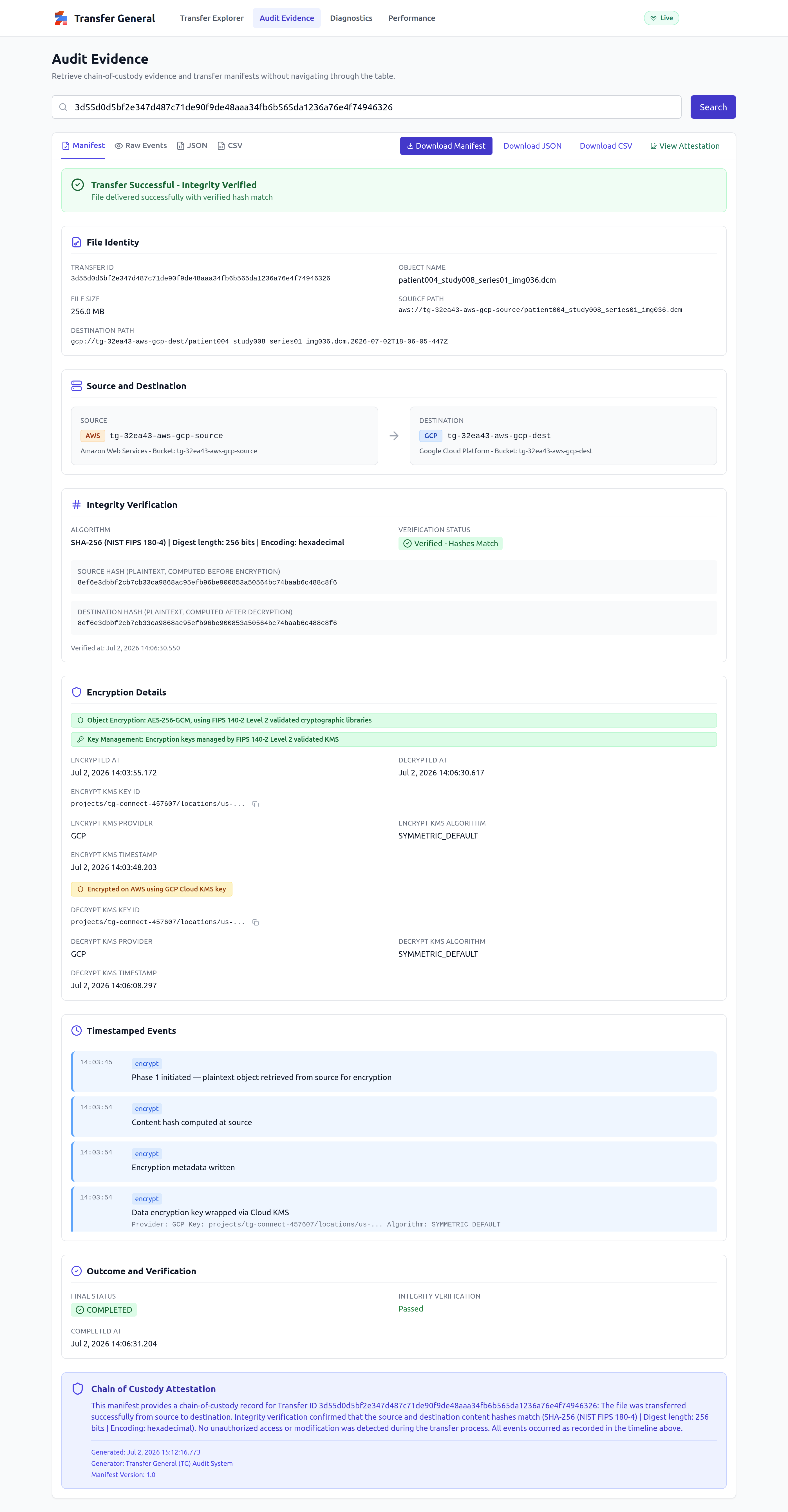
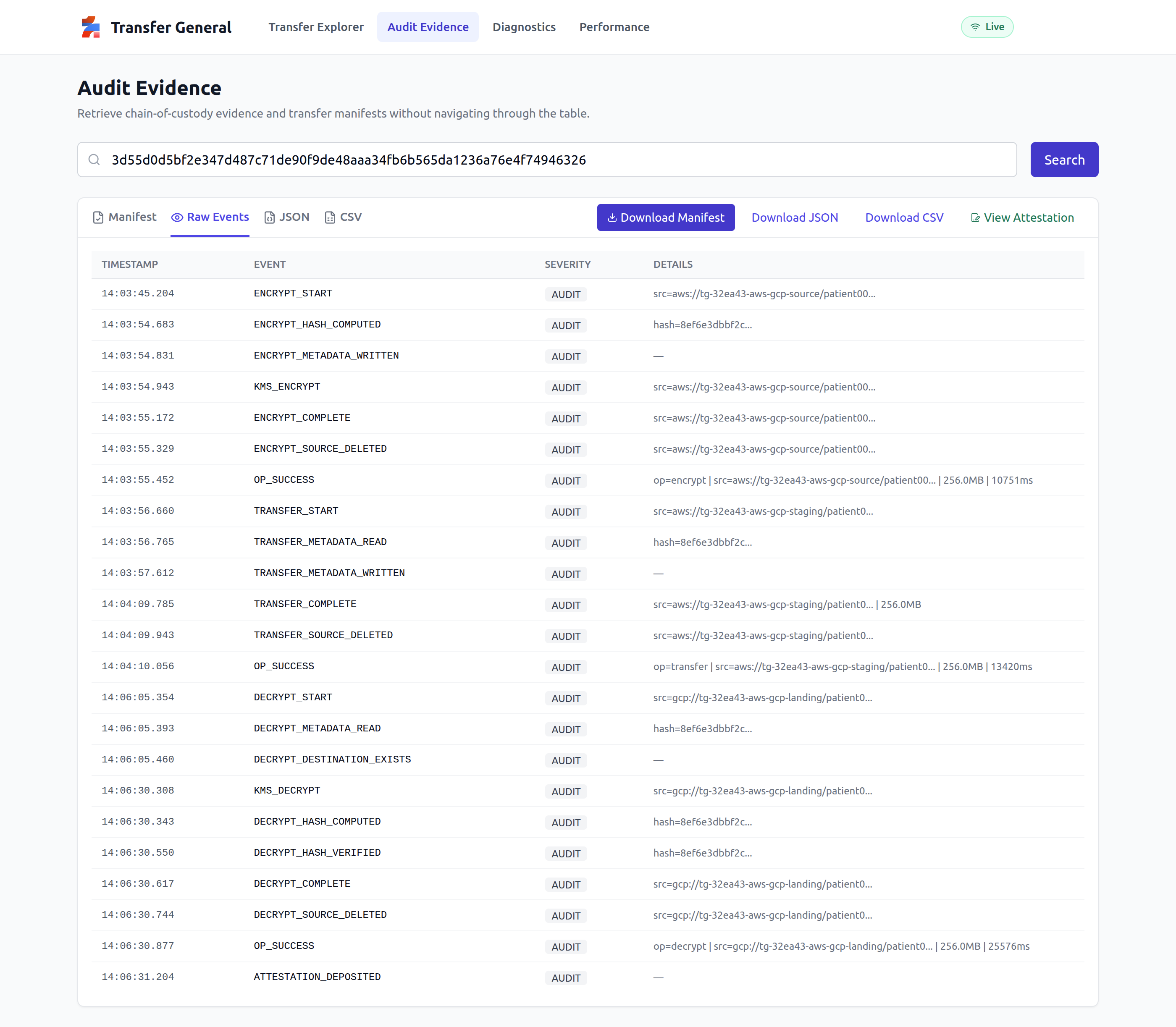
Commercial Sample. The mechanism shown — plaintext hash before encryption, source hash = destination hash, FIPS-validated modules, and an independently verifiable signed record — is identical across tiers. Accountability fields (organization / personnel) are sample data.
Your boundary, your keys, your proof — in 30 minutes
Transfer General is software you run, not a service you hand your data to. It produces the cross-boundary evidence — and the exchange documentation — that the crossing leaves to you.
- ✓Runs entirely inside your own authorization boundary. Server General never holds your keys and is never in the object data path; at the Federal tier, the signing key is held in your own KMS as well.
- ✓Places no new authorization burden on you — it runs inside your boundary, makes no outbound call, and returns no data to Server General, so it neither widens your authorization boundary nor adds an external service to account for.
- ✓Computes integrity on the plaintext object before encryption, and re-verifies the plaintext at the destination — so the integrity value is yours, independent of either cloud’s native metadata.
- ✓Produces one signed, independently verifiable record per object, covering the full cross-cloud journey — no correlating two logging systems by hand.
- ✓Gives you the completed exchange documentation for CA-3 — the interface, how the data is protected, the controls, the impact level — ready to attach to your SSP.
- ✓Up and running in under 30 minutes.
Up and running in 30 minutes. Proof handed to you, not assembled by you.
Those are the two things stitching native logs together will never give you: a compliant cross-cloud pipeline running in under 30 minutes, and per-object proof produced for you at the moment of transfer.
Transfer General supplies the compensating controls, the evidence, and the exchange documentation for the crossing. The authorization determination is always the agency’s.
Informational only, not compliance or legal advice. References are to the FedRAMP program and NIST SP 800-53; readers should consult the authoritative publications and their own assessors. Transfer General supplies compensating controls, evidence, and exchange documentation for cross-boundary transfers; authorization determinations rest with the agency.